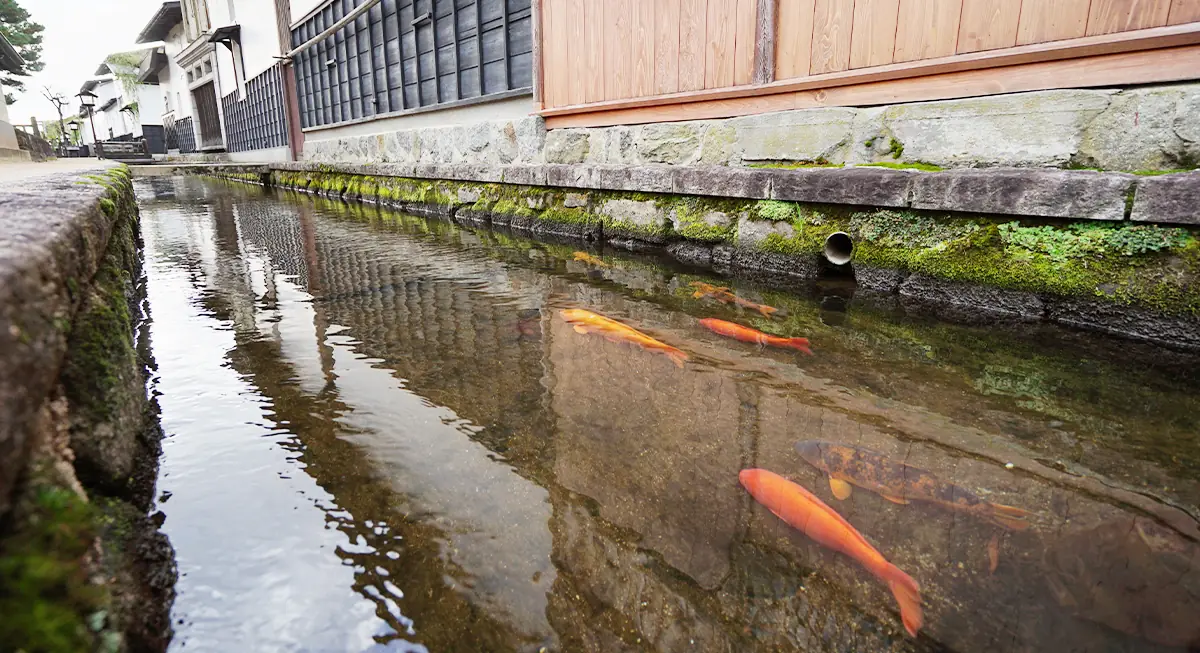
In most cities, drainage canals fade into the background. They run along streets and do their job without much notice. In Shimabara, they stand out for a completely different reason. The water runs clear, and koi swim right through the channels, visible from sidewalks and small bridges. It’s not a common sight across Japan. It works here because of very specific local conditions.
A Water System That Changed Over Time
View this post on Instagram A post shared by Japan 日本 🇯🇵 Asia Travel | Hotels | Food | Tips (@japan.explores)
The reason goes back to the late 18th century. In 1792, an earthquake and tsunami linked to Mount Unzen altered the landscape and created a network of natural freshwater springs. Those springs still feed the city today by sending a constant flow of clean water through its canals.
Because the water is always moving, it doesn’t stagnate. It stays clear enough to support life that wouldn’t survive in a typical drainage system.
The koi didn’t appear on their own. In 1978, the city introduced them into a section of the canal system that runs about 100 meters through a residential area. The idea only worked because the water quality was already high.
Koi are sensitive to their environment. If the water quality drops, they don’t last. Their presence here does more than add color. It confirms how clean the system is.
What It Looks Like Day to Day
The canals run at street level, narrow enough to stand beside without thinking much about them until you notice movement. The fish pass slowly through the current, sometimes gathering in clusters where the flow shifts.
They’re not contained in a pond or separated from the surroundings. They move through the same channels that carry water past homes and shops. A specific stretch known as Koi no oyogu machi, or “Carp Swimming Street,” is where this is most visible.
Most drainage canals in Japan are not suitable for fish, and releasing them into those environments would create problems rather than improve them. Shimabara works because of its water source and the way the system is maintained.
Without the constant flow of spring water, the canals would function like any other.
The system doesn’t maintain itself. Residents take an active role in keeping the canals clean, which helps preserve the conditions the fish rely on. Over time, that effort has become part of how the place operates.